Mass dog vaccination in India: A One health approach to rabies prevention
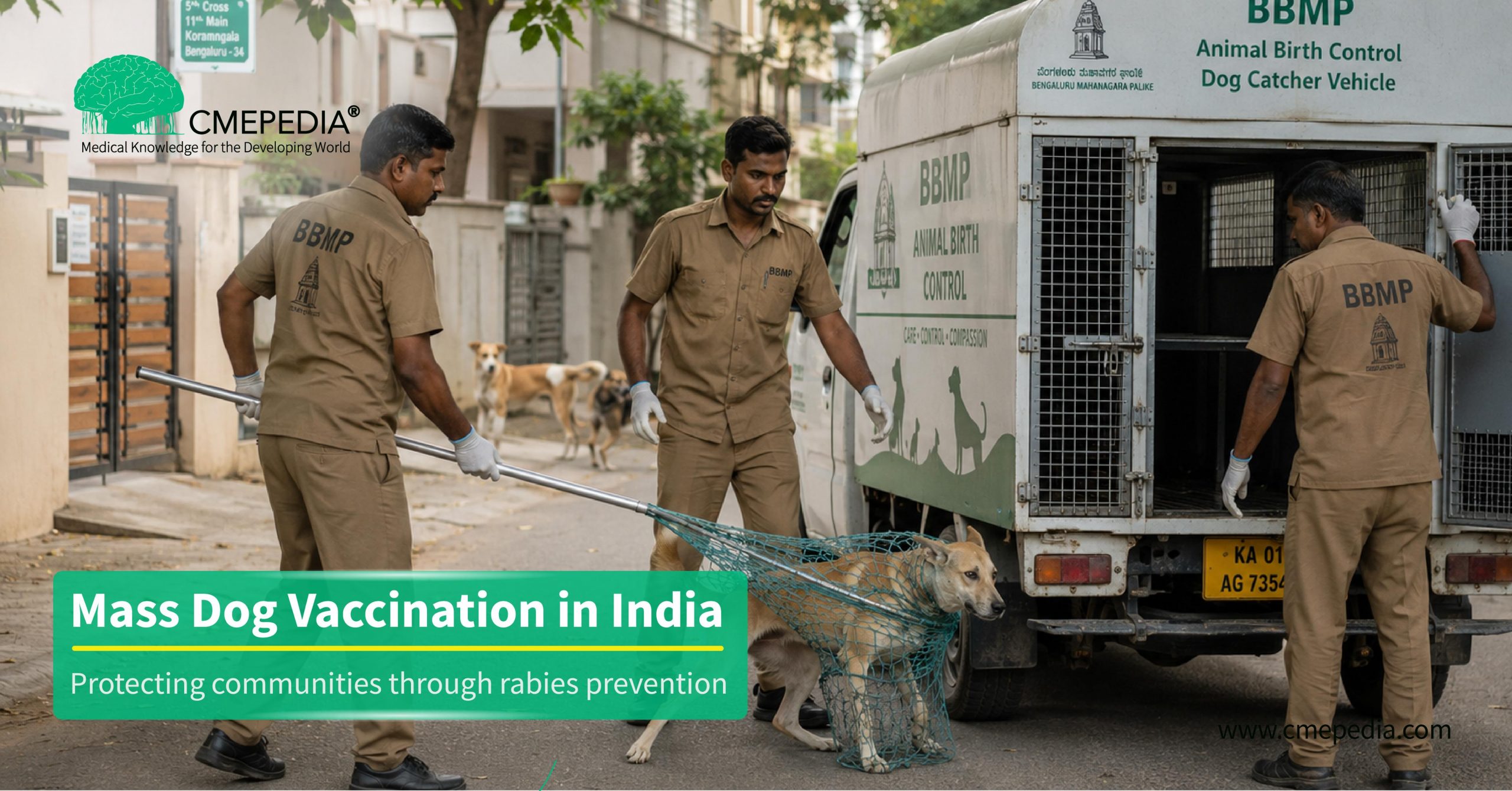
Mass dog vaccination in India is becoming an increasingly important part of India’s strategy to eliminate dog-mediated rabies. A recent initiative by the Bruhat Bengaluru Mahanagara Palike (BBMP) demonstrates how this strategy is being implemented by integrating a combined vaccination programme for street dogs into the city’s ongoing Anti-Rabies Vaccination (ARV) drive. Alongside rabies vaccination, the programme also includes protection against canine distemper, parvovirus, leptospirosis, hepatitis, and parainfluenza, with a target of vaccinating approximately 1.84 lakh street dogs.
For many, this may appear to be a municipal animal welfare initiative. However, for healthcare professionals, it represents something much more significant. It demonstrates how coordinated public health action, veterinary services, and community-level disease prevention work together to reduce the risk of human rabies and support India’s long-term goal of eliminating dog-mediated rabies.
The evidence behind mass dog vaccination in India
Dogs are responsible for the vast majority of human rabies transmission worldwide, and India accounts for a substantial share of the global burden of dog-mediated human rabies deaths. Because the disease has no cure once clinical signs appear, prevention at the source, the dog population is the only strategy that can end transmission rather than simply respond to it case by case.
Disease modelling and field data consistently show that maintaining rabies vaccination coverage of approximately 70% of a dog population is sufficient to interrupt transmission between dogs and, consequently, from dogs to humans. This threshold underpins the World Health Organization’s “Zero by 30” global strategic plan, which aims for zero human deaths from dog-mediated rabies by 2030. Coverage below this threshold allows the virus to persist in unvaccinated pockets, which is why campaign completeness, reaching every neighbourhood, not just easily accessible ones, matters as much as the raw number of dogs vaccinated.
One Health: Why this cannot be a single-sector effort
Rabies control is frequently cited as a textbook case for the One Health approach, which recognises that human, animal, and environmental health are interconnected and must be addressed together. In India’s context, this means:
- Veterinary services conducting dog population surveys, sterilisation, and vaccination
- Human healthcare providers managing bite wounds and administering post-exposure prophylaxis
- Public health authorities coordinating surveillance and making rabies a notifiable disease
- Local governments, such as municipal corporations, are implementing and funding vaccination drives
- Communities, whose participation and awareness directly affect vaccination coverage and bite reporting
India formalised this coordination through the National Action Plan for Dog-Mediated Rabies Elimination (NAPRE), launched in 2021, which provides a policy framework that guides states in developing their own State Action Plans for Rabies Elimination (SAPREs) tailored to local needs. No single sector- veterinary, medical, or administrative- can eliminate dog-mediated rabies on its own; the disease sits precisely at the intersection of these sectors that are meant to cover.
Oral rabies vaccine research: A promising but unproven frontier
Injectable rabies vaccination of free-roaming dogs is logistically demanding. It requires trained personnel to safely capture, restrain, and inject dogs that may be fearful or aggressive, as well as a functioning cold chain and repeat visits to sustain coverage. These constraints are a major reason why community dogs remain harder to vaccinate consistently than owned pets.
To address this, a diagnostic laboratory in Bengaluru, working in collaboration with national research institutes, is developing an oral rabies vaccine for free-roaming dogs, using a modified viral vector designed to trigger an immune response when delivered via edible bait rather than injection. In principle, oral bait vaccination could reduce the manpower and handling risks associated with injectable campaigns and improve reach into populations that are difficult to capture. In practice, the vaccine is still in early clinical evaluation, moving from laboratory and animal studies toward field trials over the coming years. It is not yet a standard tool, and any eventual rollout would depend on further safety and efficacy data and regulatory approval. Oral rabies vaccines have, however, been used successfully to control rabies in wildlife populations elsewhere for decades, which offers a useful precedent as this research develops.
The continued role of healthcare professionals
Even a highly effective mass dog vaccination programme does not remove the need for clinical vigilance. Healthcare professionals remain the frontline for:
- Wound management — thorough washing of bite and scratch wounds, which significantly reduces viral load
- Post-exposure prophylaxis (PEP) — timely administration of the anti-rabies vaccine series following a potential exposure
- Rabies immunoglobulin — administered in category III exposures to provide immediate passive immunity
- Vaccination schedules — correctly sequencing and completing PEP regimens per current guidelines
- Patient counselling — helping patients understand exposure risk categories and the urgency of treatment
- Public awareness — reinforcing accurate information about bite response and dispelling myths that delay care
Because rabies prevention guidelines, vaccine formulations, and regional epidemiology continue to evolve, clinicians benefit from staying current through structured continuing education rather than relying on training from earlier in their careers.
Supporting lifelong learning in public health
Programmes like BBMP’s combined vaccination drive and Bengaluru’s oral vaccine research illustrate how rapidly the practical and scientific landscape of rabies prevention is shifting. In keeping pace with this evidence, new vaccination modalities, updated PEP protocols, and evolving One Health coordination models are among the areas that continuing healthcare education is meant to support. Mass dog vaccination in India is only one part of India’s rabies elimination strategy.
Healthcare professionals also play an essential role through timely wound management, post-exposure prophylaxis, patient counselling, surveillance, and community education. Staying current with evolving evidence and national guidelines is therefore an important part of clinical practice.
Continuing healthcare education helps clinicians keep pace with these developments. CMEPEDIA supports this ongoing learning by providing evidence-based educational resources designed to help healthcare professionals strengthen their knowledge, apply current best practices, and continue developing throughout their careers.


