One Nation One Subscription: Expanding access to global research for India’s healthcare professionals
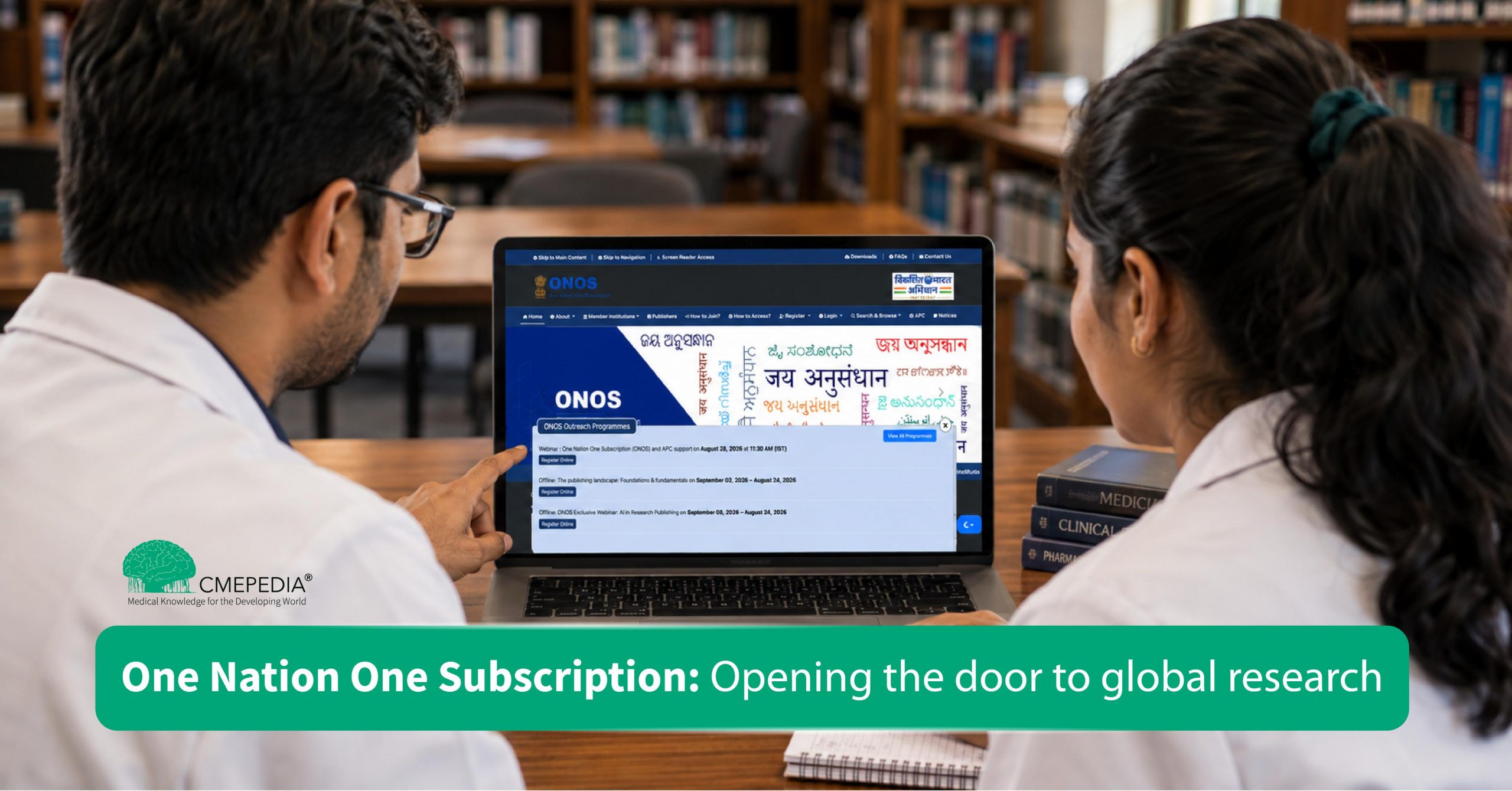
The best healthcare decisions begin with the best evidence. Every day, healthcare professionals rely on scientific research to guide diagnosis, treatment, education, and patient care. Yet for many institutions in India, accessing leading international research journals has remained expensive and challenging.
The Government of India’s One Nation One Subscription (ONOS) initiative aims to change that. Launched on 1 January 2025 by the Ministry of Education in collaboration with the Office of the Principal Scientific Adviser and the Information and Library Network (INFLIBNET) Centre, ONOS is a national initiative designed to expand access to high-quality international scientific literature for institutions across the country.
For researchers, this is more than a new policy. It represents an important step towards improving access to knowledge that supports research, education, and evidence-based practice.
Why ONOS was introduced
ONOS was approved by the Union Cabinet on 25 November 2024, following years of discussion about how to make scholarly research more accessible in India. It builds on the objectives of the National Education Policy (NEP) 2020, which identified research as a key driver of educational quality and national progress, and complements the work of the Anusandhan National Research Foundation (ANRF), established to strengthen India’s research culture, especially in institutions that have historically had limited access to global scholarship.
By negotiating subscriptions at a national level, the government aims to reduce disparities in research access and strengthen India’s long-term research and innovation ecosystem.
Before ONOS, access to major international journals was typically negotiated institution-by-institution or through smaller consortia, which meant that well-funded universities and research centres had far better access than smaller colleges and regional institutions. ONOS consolidates this into a single, centrally negotiated national subscription, funded by the government rather than paid individually by each institution.
The scheme has been allocated a budget of approximately ₹6,000 crore over three years (2025–2027), with an additional dedicated fund of ₹150 crore per year to support Article Processing Charges (APCs), helping Indian researchers publish their own work in high-quality open-access journals.
How ONOS benefits healthcare education and research
ONOS Phase I currently provides access to more than 13,000 journals from 30 major international publishers to over 6,300 government-funded higher education and R&D institutions, benefiting an estimated 1.8 crore students, faculty, and researchers nationwide. Access is coordinated through INFLIBNET via institutional (campus IP) or individual login credentials.
For the healthcare sector specifically, this matters in several concrete ways:
- Medical colleges and universities gain access to journals across medicine, nursing, dentistry, and allied health sciences that may previously have been out of reach for smaller or regional institutions.
- Faculty and researchers can review current international literature when designing curricula, guiding student research, or publishing their own findings.
- Clinicians affiliated with government institutions can consult recent studies relevant to their specialties, supporting more informed clinical reasoning.
- Tier-2 and Tier-3 institutions, which have historically had less access to premium journals than large metro universities, stand to benefit disproportionately, helping narrow long-standing gaps in research infrastructure across the country.
- Healthcare professionals preparing clinical guidelines, systematic reviews, or evidence-based teaching materials can more easily access current international literature.
Why better access to research matters
Access to international scientific literature is about more than reading research papers. It helps researchers to stay informed about evolving clinical guidelines, emerging treatments, and advances in medical science. It helps researchers stay informed about evolving clinical guidelines, emerging treatments, and advances in medical science.
By improving access to trusted scientific evidence, initiatives like ONOS can help strengthen research, innovation, and lifelong learning across India’s healthcare ecosystem.
Why access to international scientific literature matters
The scale of ONOS gives a sense of how significant this shift has been. As of writing, the scheme covers over 6,500 member institutions across the country, with access to more than 13,000 full-text journal titles from over 30 global publishers, spanning STEMM, management, social sciences, and humanities. Institutions access this content via IP-based and off-campus logins, meaning researchers and faculty can also access subscribed content from outside their campus network.
The jump from the pre-ONOS landscape is documented in the government’s own presentation on the scheme: the number of students, faculty, and researchers with access rose from 56.7 lakh before ONOS to 177.82 lakh after, a 213.6% increase, while the number of beneficiary institutions grew from 2,360 to 6,380, a 170.3% increase. Journal titles available under the consortium rose from 8,079 to 13,400.
Just as significant for researchers is the shift in the kind of access: institutions that previously had discipline-specific subscriptions now have all journals available to all users, which the government frames as a way to support interdisciplinary research rather than confining scholars to a narrow slice of literature tied to their department’s prior subscriptions.
This matters most for researchers precisely because their work depends on knowing what already exists. Before drafting a study, designing a methodology, or identifying a genuine gap in the literature, a researcher needs to see the full landscape of prior work, not just the journals their institution happened to subscribe to. A scheme that expands access from roughly 2,360 to over 6,500 institutions, and removes the discipline-specific ceiling on what each user can read, directly addresses that dependency.
Whether this translates into a sustainable long-term model is a separate question, one that commentary on the scheme has raised, including around the balance between subscription-based and open-access publishing as more global research shifts toward open models. But on access alone, the scale of uptake so far represents a meaningful change for India’s research community.
How Initiatives like ONOS complement continuing healthcare education
Improving the availability of scientific journals is an important step in strengthening healthcare education, but it is only one part of lifelong learning. Reading research alone does not automatically improve clinical practice. Healthcare professionals also need opportunities to understand new evidence, evaluate its clinical relevance, and apply it confidently through continuing medical education (CME), accredited learning activities, and ongoing professional development.
Keeping up with international research helps healthcare professionals stay informed about advances in medicine. Continuing healthcare education builds on that knowledge by helping clinicians interpret research, understand changing guidelines, and translate new evidence into everyday practice. CMEPEDIA supports this approach by providing evidence-based educational resources that help doctors, nurses, dentists, and other healthcare professionals continue learning throughout their careers.
Reliable scientific literature, combined with high-quality continuing education, strengthens evidence-based practice, supports informed clinical decision-making, and contributes to better patient care.
Conclusion
The One Nation One Subscription (ONOS) initiative represents an important investment in India’s research and education ecosystem. By making international scientific journals available to thousands of institutions, it has the potential to strengthen research, improve healthcare education, and encourage wider adoption of evidence-based practice.
For healthcare professionals, educators, and researchers, staying current with reliable scientific evidence is only the beginning. Turning new knowledge into better patient care requires continuous learning, critical thinking, and regular opportunities to apply the latest evidence in clinical practice. Continuing healthcare education helps bridge that gap by supporting lifelong professional development.
CMEPEDIA contributes to this journey by providing evidence-based healthcare education that helps doctors, nurses, dentists, and other healthcare professionals keep pace with evolving medical knowledge and deliver high-quality patient care.


