Retracted articles: Why they remain difficult to spot
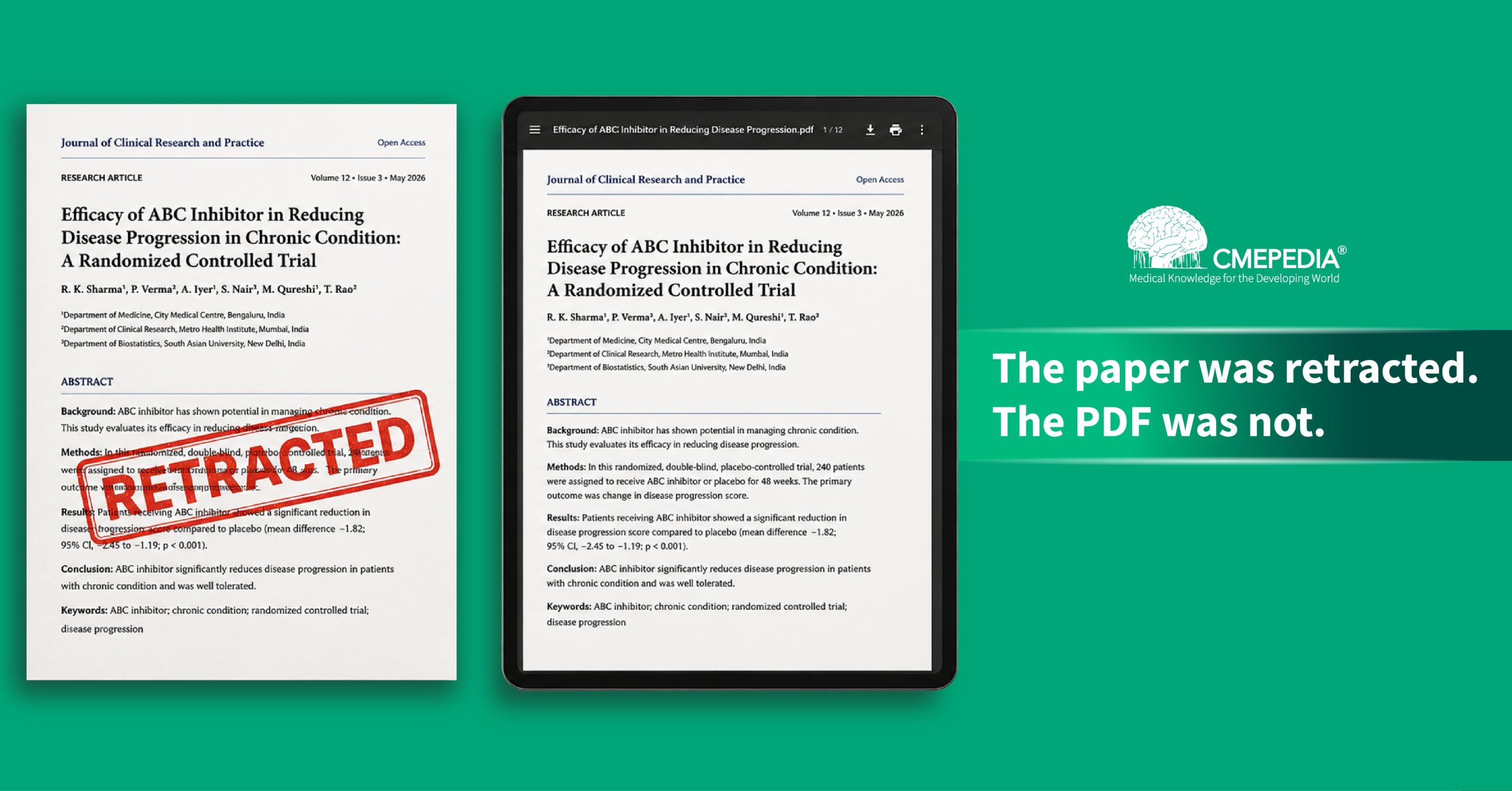
Retracted articles can continue circulating through inboxes, reference managers, shared folders, and downloaded PDFs, even after journals formally withdraw them. To an unsuspecting reader, a withdrawn paper may look exactly as it did on the day it was published. A healthcare professional could unknowingly use its findings in a presentation, literature review, educational module, or research project. Retraction systems can protect healthcare knowledge only when warnings follow the article wherever it is accessed. When that warning becomes separated from the paper, unreliable findings can remain hidden in plain sight.
Retraction does not mean disappearance
Retracted articles usually remain accessible because retraction corrects the scholarly record rather than erasing it. Keeping the original paper available preserves the publication history and allows readers to understand what was withdrawn and why. However, it must be unmistakably labelled as retracted. COPE’s retraction guidelines state that retraction is intended to correct the literature and preserve its integrity, not punish authors. The problem arises when the warning is unclear, missing from a downloaded copy, or separated from the version a reader encounters.
Retracted articles are increasing, but remain rare
Retracted articles account for only a small proportion of published research, although retraction rates have risen over time. An analysis cited by The BMJ reported an increase from 0.38 retractions per 10,000 publications in 1985 to 2.03 in 2000 and 5.95 in 2014. It also found that articles took an average of 3.8 years to be retracted. During that time, a paper may be downloaded, cited, taught, or incorporated into further research. Rising numbers do not necessarily indicate that research is becoming less trustworthy. They may also reflect stronger systems for detecting problems and correcting the literature.
How retraction warnings become separated from articles
Retraction notices for retracted articles may be clearly displayed on journal websites, yet remain invisible elsewhere. A PDF downloaded before the retraction does not automatically update when it is stored on a computer, institutional drive, messaging platform, or reference manager. The same paper may also appear in repositories or on third-party websites that do not display its revised status or provide a link to the retraction notice.
Metadata creates another potential gap. If a publisher updates the article page but does not promptly update the information supplied to databases and indexing services, readers may receive inconsistent signals across platforms. Retraction notices may also be hard to find or unclear about which findings can no longer be trusted. Research on identifying the retracted status of an article demonstrates that retraction information is not presented consistently across commonly used sources.
Why retracted articles continue to be cited
A retraction does not automatically stop an article from being read or referenced. Researchers may cite an old PDF, copy a reference from another paper, or select an article already saved in a reference manager without checking its current status. As a result, retracted papers continue to be cited, sometimes without any acknowledgement that their findings are no longer considered reliable.
Not every citation after retraction is inappropriate. Researchers may cite a withdrawn article to discuss publication ethics, examine research misconduct, or explain why its conclusions should not be used. The greater concern arises when it is cited positively as valid evidence. In those cases, unreliable claims can become embedded in later studies, reviews, presentations, and educational materials, extending a paper’s influence long after its formal retraction.
Why poor visibility matters in healthcare
When a retraction warning is missed, unreliable evidence may unintentionally enter clinical presentations, journal clubs, continuing medical, nursing, or dental education, and teaching materials used by hospitals and medical colleges. It may also influence literature reviews, research proposals, patient education resources, institutional protocols, and evidence summaries.
The problem can extend further when retracted publications appear in systematic reviews. Because systematic reviews may inform education, research priorities, and healthcare decisions, the inclusion of unreliable evidence requires careful assessment. However, one retracted citation does not automatically invalidate every document that includes it. The effect depends on why the paper was retracted, how significantly the document relied on its findings, and whether independent, reliable evidence supports the same conclusion. Each case should therefore be evaluated carefully rather than dismissed without context.
How to check whether an article has been retracted
A few practical checks can help healthcare professionals and educators verify an article before using it.
Check the journal’s article page
Open the current publisher page and look for a retraction notice, correction, or expression of concern. Do not rely only on a previously downloaded PDF.
Search PubMed
When the necessary information has been indexed, PubMed links retraction notices to the affected articles and labels the original records as retracted publications.
Check the DOI and Crossmark
Follow the article’s DOI to its current record. Where Crossmark is available, it allows readers to check the current status of an article, including corrections, updates, and retractions.
Search the retraction watch database
The Retraction Watch Database provides another way to investigate an article, particularly when its status differs across platforms. No database is perfect, so important sources should be checked through more than one channel.
Making retractions visible is a shared responsibility
Publishers should clearly label every available version of a retracted article and provide freely accessible notices linked to the original paper. They should also update DOI metadata and notify bibliographic databases promptly. Databases and repositories must ensure that these changes remain visible to users. Healthcare institutions should periodically recheck references used in active protocols, educational resources, and evidence summaries.
Educators should also verify important sources before reusing older presentations or learning modules. Following COPE’s recommendations for visible retraction notices can help journals, institutions, and healthcare education platforms prevent outdated or unreliable findings from circulating without context.
Conclusion: Correction only works when readers can see it
Retraction is an essential part of responsible publishing. The problem is not that withdrawn articles remain within the scholarly record, but that readers may encounter them without seeing their updated status. Healthcare professionals should therefore verify important evidence before using it in education, research, or practice.
CMEPEDIA supports this principle through a withdrawal procedure that informs subscribers when educational content is withdrawn and explains the reason.
Take your healthcare learning forward with CMEPEDIA.


