Value of continuing medical education: Beyond CME hours
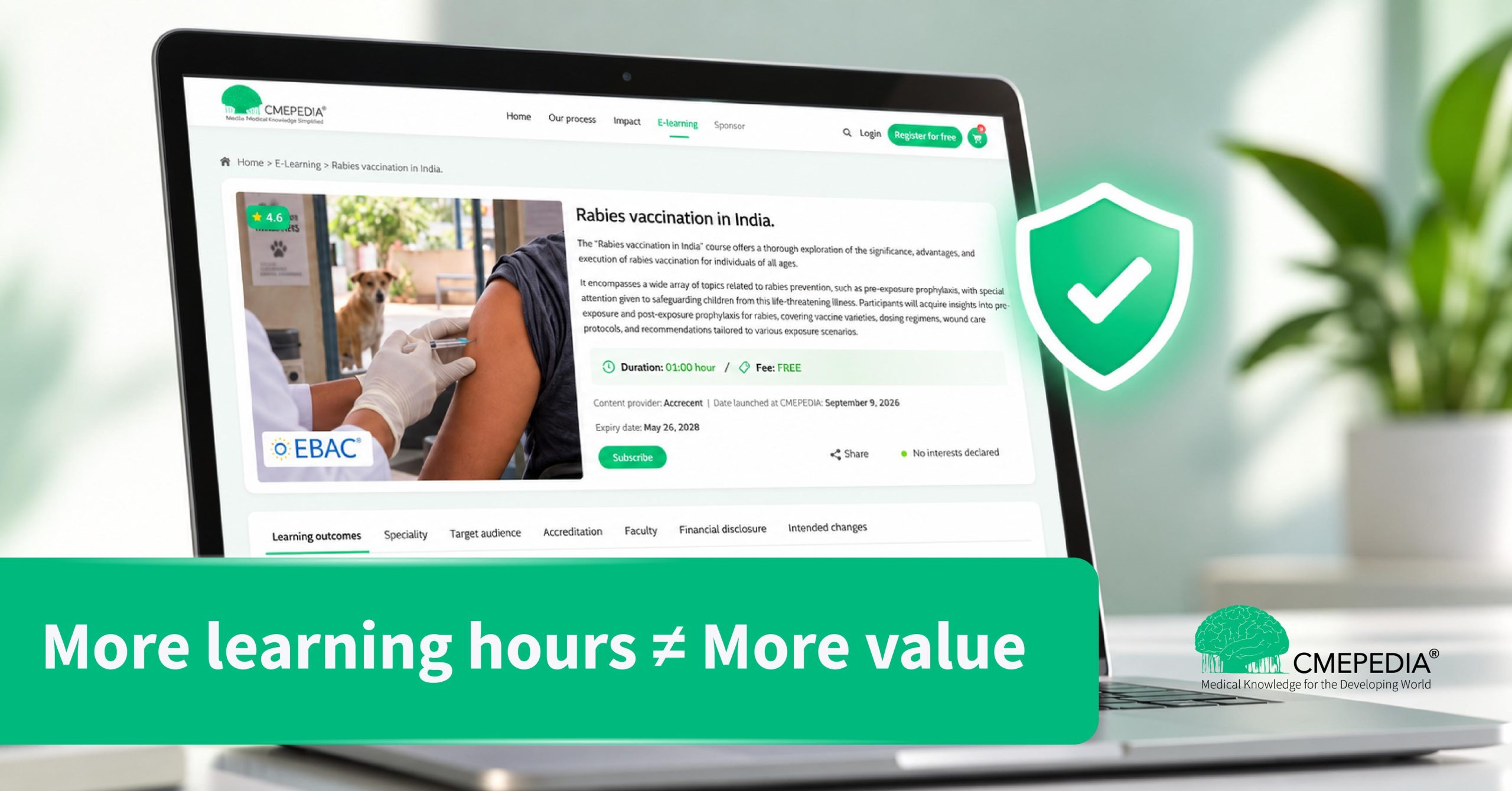
The value of continuing medical education cannot be measured only by the number of hours healthcare professionals spend learning. Throughout their careers, they attend conferences and webinars, complete courses, read research, and collect continuing education credits. These activities support professional development, but attendance records and certificates reveal little about what a learner understood, retained, or applied in practice. What, then, makes professional education genuinely valuable?
Digital technology has made knowledge from institutions and experts worldwide easier to access. However, access is only the beginning. The usefulness of learning ultimately depends on its credibility, relevance to professional needs, and thoughtful application within the healthcare setting.
Why learning hours alone cannot measure the value of continuing medical education
Attendance records, travel, study hours, and certificates show that a healthcare professional participated in an educational activity. They do not, by themselves, demonstrate that the participant gained knowledge, developed competence, changed professional practice or contributed to better patient outcomes.
A programme may require several hours yet provide limited value if its evidence is outdated, its scope is too broad, or its objectives do not match the learner’s needs. For example, a clinician seeking guidance on preventing medication errors may gain little immediate value from a general programme that does not address patient safety.
This does not mean conferences, webinars or credit systems lack purpose. Their usefulness depends on educational quality, relevance and how learning is applied in practice. Evidence from a 2026 systematic review of healthcare continuing education found that e-learning can improve knowledge, confidence, attitudes and selected skills, while evidence of sustained practice change and patient-related outcomes remains limited and varies across studies.
What determines the value of continuing medical education?
Valuable professional education begins with clear objectives connected to genuine learning needs. Its information should be current, evidence-based, and delivered or reviewed by educators with relevant expertise. Learners should also be able to identify who developed the material, how it was funded, and whether potential conflicts of interest were disclosed. These safeguards help protect educational independence and allow participants to evaluate information critically.
Quality education involves more than listening or watching. Discussions, case-based activities, reflection, assessment and constructive feedback can help learners examine what they understand and where further learning is required. The material must also be applicable to the learner’s role, patient population and available healthcare resources.
The WFME Standards for Continuing Professional Development emphasise a systematic approach to professional learning, while Moore’s framework separates participation from knowledge, competence, professional performance and patient or population outcomes. These levels should not be treated as interchangeable. Completing a course may support learning, but it does not prove that professional practice changed or patient outcomes improved. Meaningful value depends on what happens during and after the educational activity.
The information healthcare professionals consume matters
Medical publications, clinical guidelines, educational programmes, professional media and digital platforms can all influence healthcare decisions. However, receiving more information does not necessarily provide greater clarity. Outdated evidence, incomplete reporting and promotional material presented as education can make it difficult to distinguish reliable guidance from weaker claims.
Healthcare professionals should therefore examine who created the information, the author’s qualifications, and when the material was published or reviewed. They should also check references, funding sources, and conflict-of-interest disclosures. Equally important is assessing whether the evidence is strong, relevant and applicable to the intended healthcare setting.
The World Health Organization describes an infodemic as an excessive amount of information, including false or misleading information, during a disease outbreak. This does not mean all online healthcare information is unreliable. It shows why professionals need critical appraisal skills to identify trustworthy information within a crowded digital environment.
Global knowledge still requires local judgement
The value of continuing medical education depends partly on how well global knowledge addresses local healthcare needs. Balaji Srinivasan has written about technology enabling online communities to connect through the cloud and later take shape in the physical world. Applied to healthcare education, this idea suggests that professionals can access knowledge globally while remaining rooted in the communities where they practise.
A doctor, nurse, dentist, or medical educator in India can learn from international research, educators, and professional networks without being limited by geography. However, global access does not make every recommendation directly suitable for local use. International evidence may need to be considered alongside Indian clinical guidance, local disease patterns, patient preferences, language, health literacy, and the availability of medicines and technology.
Institutional resources and applicable professional requirements also affect whether learning can be implemented safely and effectively. International evidence can broaden understanding and inform professional decisions, but it still requires critical evaluation. The objective is not simply to import global knowledge, but to interpret it responsibly within the realities of Indian healthcare practice.
Digital education can improve access, but quality still matters
Digital education can give healthcare professionals flexible access to specialised topics, international educators, and resources that may not be available locally. It may reduce the need to travel for every educational activity, while recorded courses and webinars allow learners to revisit complex information at a suitable time.
However, convenience alone does not determine the value of continuing medical education. Effective digital learning depends on the quality of its evidence, instructional design, learner participation, assessment, feedback and relevance to professional needs. A World Health Organization review of digital education found that outcomes vary according to the learning objective, digital method, and way the programme is implemented.
Digital education should therefore complement rather than completely replace supervised clinical experience, practical training, simulation, mentorship and peer interaction. Certain knowledge can be developed online, but clinical and procedural skills may require direct observation and guided practice. The appropriate balance depends on the subject, learner, and intended outcome.
How to choose learning that creates real value
Before selecting a course, webinar, conference or digital resource, healthcare professionals should first consider whether the topic is relevant to their role and current learning needs. Clear learning objectives can help them understand what they are expected to gain from the activity. They should also review who developed the material, who reviewed it, and whether the information is current and supported by credible references.
Funding sources and potential conflicts of interest should be disclosed transparently. Activities that encourage participation, reflection, assessment and feedback may offer greater learning value than passive attendance alone. Professionals should also consider whether the knowledge can be applied within their healthcare setting and whether it aligns with relevant institutional or professional requirements. Ultimately, the influence of learning on knowledge or practice matters more than the number of hours printed on a certificate.
Making every learning hour count
Completing more educational activities does not automatically create greater professional value. The value of continuing medical education depends on whether learning is relevant, credible, reflective, and applicable to real healthcare needs. Digital access allows professionals to learn from institutions, educators and resources beyond geographical boundaries, but professional judgement remains essential when applying that knowledge locally.
CMEPEDIA helps healthcare professionals access educational resources from different content providers without requiring travel for every learning opportunity. Doctors, nurses, dentists, educators, and institutions can visit CMEPEDIA to identify resources aligned with their roles, interests, and professional learning needs. Ultimately, every learning hour should build understanding and support more informed professional decisions.


