Medical research access in India: Barriers and solutions
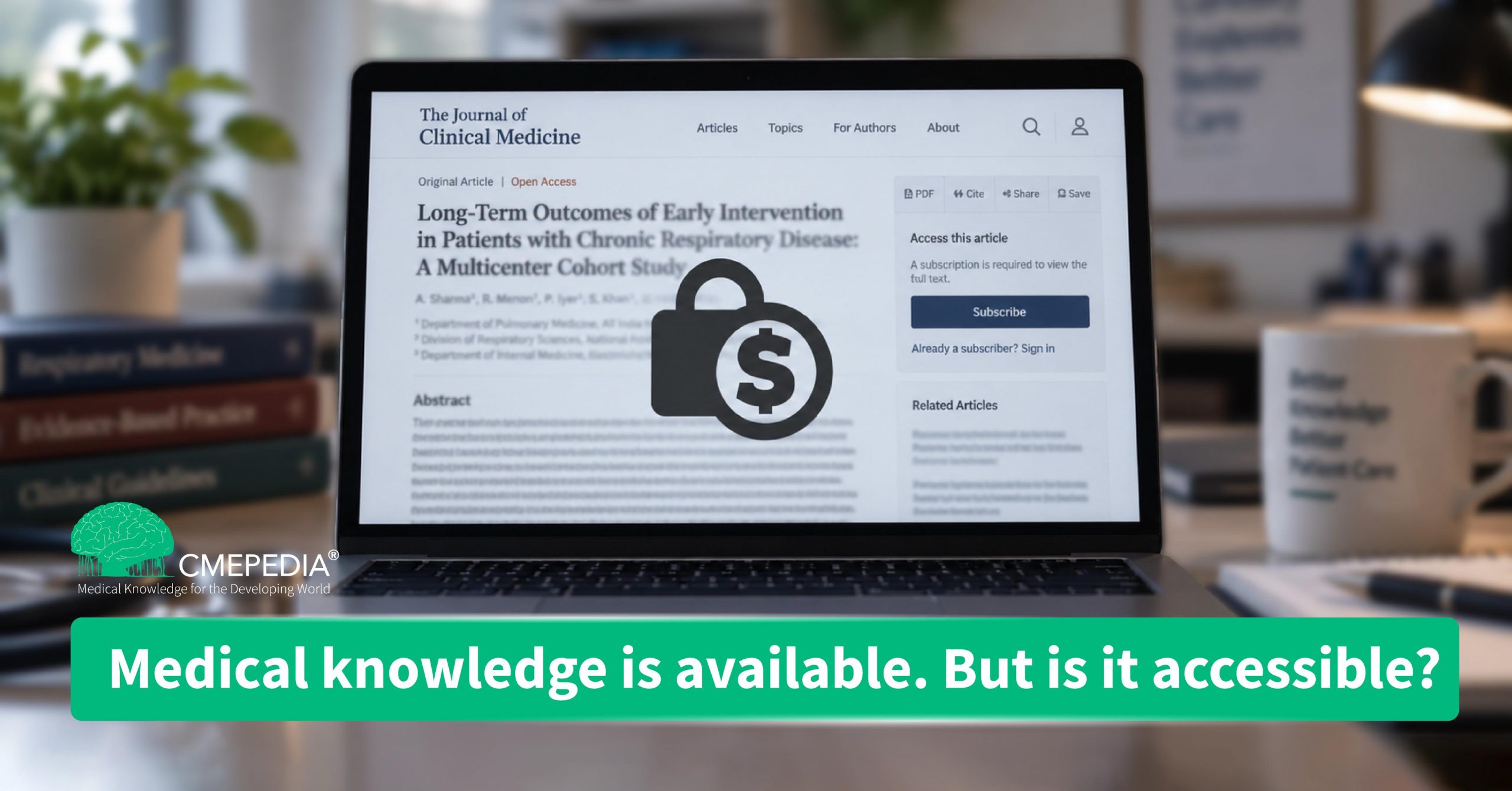
Medical research access in India remains unequal for many healthcare professionals. A doctor in private practice may identify a recent study relevant to a patient’s condition, only to discover that the complete article requires institutional access or payment. A nurse preparing an educational session or a dental educator updating course material may face the same difficulty.
Finding a study’s title or abstract is not the same as accessing the full evidence. Important information about the research methods, participants, limitations, and findings is generally available only in the full article.
Digital resources and national initiatives are expanding access to medical knowledge in India, but access remains unequal. Understanding the barriers and knowing where to find legitimate resources can help healthcare professionals use research more responsibly.
Improving medical research access in India
Medical research has become easier to find online, but finding an article does not necessarily mean you can read it in full. Many academic journals allow readers to view an article’s title and abstract while limiting access to the complete paper to subscribers or paying readers.
This can create difficulties for healthcare professionals who are not connected to an institution with relevant journal subscriptions. Although an abstract provides a summary, it may not contain enough information to assess the study design, participant selection, results, and limitations.
Access may also depend on whether a professional is associated with a university, medical college, teaching hospital, or research institution. Institutional libraries can provide eligible staff and students with access to subscribed journals and databases. However, this access may change when a professional leaves the institution or begins working independently.
Research resources also vary by institution. Therefore, two healthcare professionals looking for the same evidence may not have access to the same material. The UNESCO Recommendation on Open Science recognises unequal access to scientific knowledge as an important challenge and calls for scientific knowledge to be made more openly available and accessible.
Why reliable knowledge access matters in healthcare
Medical research contributes to the development of clinical guidelines, healthcare education, academic work and evidence-informed decision-making. It can also inform the development of CME, CNE and CDE activities that reflect current knowledge and changing professional needs.
However, access to a research paper does not automatically lead to a better clinical decision. Evidence must be evaluated for its quality, relevance and currency. Healthcare professionals should also consider whether the study population, clinical setting and findings are applicable to their own practice.
The established principles of evidence-based medicine emphasise integrating the best available research evidence with clinical expertise. Decisions should also reflect the circumstances, preferences and needs of the individual patient.
One study should therefore not be used in isolation to determine clinical care. Reliable access matters, but healthcare professionals also need to interpret evidence critically and apply it responsibly.
Legitimate ways to access medical research
Open access journals and repositories
Not all medical research requires a journal subscription. PubMed Central provides free access to a large collection of biomedical and life sciences literature, while the Directory of Open Access Journals helps users find open access journals across different disciplines. Universities and research organisations may also preserve author-accepted manuscripts in their institutional repositories.
However, an article being free to read does not necessarily mean that it can be copied, modified or reused without restriction. Reuse depends on the article’s copyright status and licence. Creative Commons licences explain what readers may do with licensed material and whether attribution or other conditions apply.
Institutional and national initiatives
Healthcare professionals can also check whether their hospital, university or college library provides access through subscriptions or academic consortiums. In India, INFLIBNET supports institutions in accessing and managing scholarly information.
One Nation One Subscription is another national initiative intended to expand access to international scholarly journals for eligible government higher education and research institutions. CMEPEDIA’s separate ONOS article can provide readers with a detailed explanation of the initiative.
Research4Life programmes, including Hinari, provide access to eligible institutions in qualifying countries. Eligibility depends on factors including location and institution type, so readers should check the official Research4Life eligibility criteria rather than assume access is automatically available.
Practical steps for healthcare professionals
Professionals can begin by checking institutional library access, searching PubMed Central and DOAJ, and looking for an author accepted manuscript in a university repository. They may also contact the corresponding author when appropriate. Before sharing or reusing any material, they should confirm its copyright status and licence and avoid unauthorised websites or unverified summaries.
Access alone is not enough
Finding a complete research article is only the first step. Its availability does not automatically make its findings reliable, current or relevant to Indian healthcare practice.
Healthcare professionals should consider who conducted and funded the research, whether the study was peer-reviewed, and whether its participants and clinical setting are relevant to the population they serve. They should also examine whether other studies support the findings, whether newer evidence or updated guidelines are available, and whether the article has been corrected or retracted.
The Centre for Evidence-Based Medicine provides critical appraisal tools that can help readers evaluate different types of research. Critical appraisal enables healthcare professionals to move beyond simply finding information and towards understanding its strengths, limitations and appropriate application.
How healthcare institutions can support better access
Hospitals, medical colleges, nursing institutions and dental colleges can help make reliable knowledge more accessible to their staff and learners. They can begin by reviewing the journals, databases, and other research resources available through their libraries and ensuring that eligible users understand how to access them.
Institutions can also introduce healthcare professionals to legitimate open access platforms and provide training in literature searching and critical appraisal. Research literacy can be incorporated into CME, CNE and CDE activities so that professionals learn not only where to find evidence but also how to evaluate it.
Healthcare educators should encourage accurate citation, respect for copyright and responsible use of licensed material. They can also help learners recognise outdated, misleading or unreliable information. Equitable access requires both appropriate resources and the knowledge needed to use them responsibly.
Connecting research access with continuous education
Access to research and access to structured healthcare education serve different but complementary purposes. Research articles present original findings, while structured CME, CNE and CDE activities can help healthcare professionals understand emerging evidence within a relevant educational context.
Continuing education can support professionals in connecting new research with established knowledge, current guidelines and the realities of healthcare practice. It can also create opportunities to strengthen research literacy and critical appraisal skills.
CMEPEDIA does not replace journal subscriptions, research databases, or access to primary literature. Instead, the platform supports accessible and structured healthcare education that helps doctors, nurses, dentists and other healthcare professionals continue developing their knowledge throughout their careers.
Conclusion
Access to medical knowledge should not depend entirely on a healthcare professional’s institution or ability to pay for individual articles. However, expanding access is only part of the solution.
Healthcare professionals also need the skills to identify credible sources, evaluate the quality and relevance of evidence, and apply it responsibly. Open access resources, institutional initiatives, research literacy, and structured education can work together to support a better-informed healthcare workforce and strengthen continuous professional development across India.
Healthcare professionals can explore CMEPEDIA for accessible CME, CNE, and CDE learning opportunities that support continued learning and professional growth.


