Oral Rabies Vaccination in India: A Game-Changer for Rabies Elimination
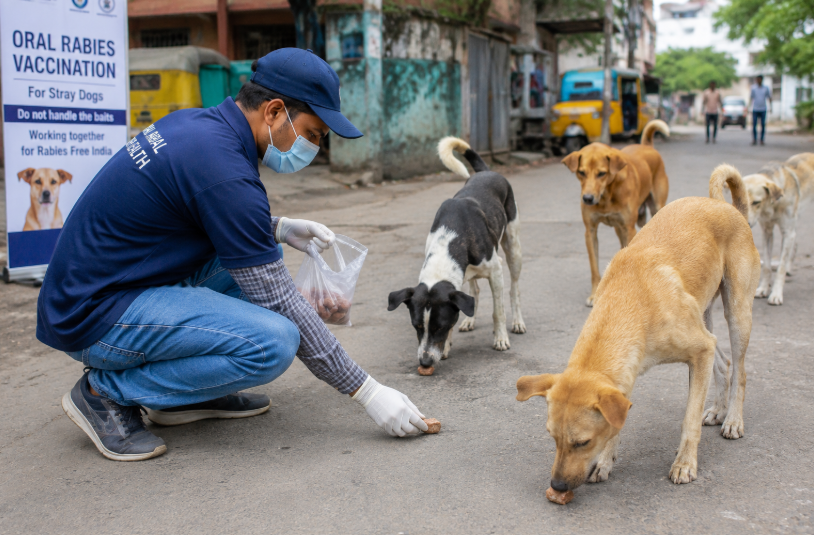
Oral rabies vaccination in India is emerging as an important strategy for controlling dog-mediated rabies and reducing preventable human deaths. Despite the availability of effective vaccines, rabies continues to cause thousands of deaths each year, mainly due to persistent transmission in free-roaming dog populations and gaps in vaccination coverage. The key challenge in India is not scientific capability, but achieving consistent vaccination coverage at scale to interrupt transmission at the animal source.
Rabies remains almost always fatal once clinical disease develops, yet is entirely preventable through timely post-exposure prophylaxis (PEP) in humans and sustained vaccination of dogs. Human Rabies Prevention: Vaccination, SafetyGuide & PrEP. Recent reports show the ongoing risk: children in Kerala have died despite receiving vaccination, Karnataka reported eight rabies deaths in two months, and Bengaluru recorded more than 13,800 dog bite cases in six months.
What Is Oral Rabies Vaccination in India?
Oral Rabies Vaccination in India refers to the use of vaccine-laden edible baits to immunise dogs without injections.
The bait is:
• Designed to attract dogs through smell and taste
• Contains a safe oral rabies vaccine
• Engineered to release the vaccine in the oral cavity when chewed
This method is especially useful for rabies vaccination of stray dogs Rabies, where animals are difficult to capture or handle safely. It helps extend protection to free-roaming dog populations that are often missed in conventional campaigns.
ORV is not a replacement for injectable vaccination but a complementary strategy to improve overall population immunity and strengthen rabies control efforts, effective when integrated with mass dog vaccination programmes. Recent Advances in Prevention and Control of Rabies: Advances in Preventive Medicine.
Why Rabies Remains a Public Health Challenge in India
Rabies persists in India due to interacting biological and system-level factors. The country bears a substantial share of the global burden, with an estimated ~36% of rabies deaths and approximately ~5,700 human deaths annually, despite the disease being fully preventable through timely vaccination and post-exposure prophylaxis (PEP). A major driver of transmission is the large population of free-roaming dogs, estimated at ~60–62 million, which serves as the primary reservoir for dog-mediated rabies. Combined with a high exposure burden of ~17–20 million dog-bite cases annually, this creates widespread and continuous risk across both urban and rural settings, with children disproportionately affected.
Sustained transmission is further reinforced by high dog population turnover and rapid immunity decay, which reduce herd immunity between vaccination rounds and lead to declining protection after campaigns. Localized “coverage islands” of unvaccinated dogs can maintain viral circulation and re-seed infection even when overall coverage appears adequate. In addition, surveillance systems remain largely reactive, detecting rabies primarily after human or livestock cases, which limits early identification of viral circulation in dog populations. Human mortality is further driven by delayed wound washing, underestimation of bite risk, and delayed initiation of PEP despite vaccine availability.
Benefits of Oral Rabies Vaccination for Free-Roaming Dogs
Oral rabies vaccination (ORV) improves control of dog-mediated rabies by addressing key operational barriers in field vaccination campaigns.
✔ Improved reach
Vaccinates free-roaming dogs that are hard to catch, especially in urban slums and remote areas.
✔ Faster, scalable coverage
Covers large dog populations quickly in high-density or hard-to-reach areas.
✔ Less manpower needed
Reduces need for capture teams, equipment, and intensive handling.
✔ Safer for workers and dogs
Lowers risk of bites, injuries, and stress during vaccination.
✔ Supports population immunity
Helps reach and maintain ~70% coverage when combined with injectable vaccination.
✔ Targeted use in hotspots
Can be focused in high-risk areas to use resources more efficiently.
✔ Proven feasibility
Shown to work in pilot studies in India and wildlife rabies control programmes in Europe
Challenges of Implementing ORV Programmes in India
Despite its advantages, ORV implementation faces real constraints.
Cost constraints :Bait production, transport, and cold chain increase programme costs.
Field logistics: Effective distribution requires mapping, planning, and monitoring.
Coverage measurement: Unlike injectable vaccination, ORV uptake is harder to verify.
Public awareness gaps: Misconceptions about bait safety can reduce acceptance.
Integration issues: ORV must align with the existing rabies control programme in India, including strategies such as sterilisation and surveillance. Without integration, ORV alone cannot achieve elimination.
How ORV Supports the One Health Approach
Oral rabies vaccination (ORV) reduces rabies risk by decreasing infection in animal reservoir populations, which are the main source of human exposure. Vaccine baits immunise free-roaming animals, lowering viral circulation and breaking transmission at its origin rather than responding after human infection occurs.
Its use requires coordination between veterinary services and public health systems, supported by surveillance data to identify high-risk areas and monitor impact.
Overall, ORV strengthens rabies control by shifting intervention upstream to animals, which directly reduces downstream human cases and supports integrated disease management.
The Future of Rabies Elimination in India
The WHO-led Zero by 2030 initiative aims to eliminate human deaths from dog-mediated rabies through at least 70% mass dog vaccination coverage, stronger disease surveillance, and universal access to post-exposure prophylaxis (PEP) within a One Health framework. This vaccination threshold is designed to interrupt sustained rabies transmission by reducing the effective reproduction number below one.
In India, however, free-roaming dogs remain the primary reservoir of rabies. High birth and death rates within these populations cause herd immunity to decline rapidly between annual vaccination campaigns, making sustained control difficult.
Oral Rabies Vaccination Can Bridge the Gap
Oral rabies vaccination (ORV) offers an important complementary strategy for reaching free-roaming dogs that are difficult to capture. Vaccine-laden baits can increase vaccination coverage in urban informal settlements and remote rural communities where conventional vaccination campaigns face logistical challenges.
However, ORV is most effective when integrated with capture-vaccinate-release programmes and geographically targeted vaccination campaigns. Success also depends on factors such as bait uptake, vaccine stability, and careful monitoring of immune response following distribution.
Challenges That Still Need to Be Addressed
Despite effective vaccines, several operational challenges continue to slow India’s progress towards rabies elimination.
Dog population estimates vary considerably, making it difficult to accurately measure vaccination coverage. Localised pockets of unvaccinated dogs can continue transmitting the virus even when overall vaccination rates appear sufficient.
Surveillance also remains largely passive, with many cases identified only after human or livestock infections occur. Delays in wound washing, incomplete or late initiation of post-exposure prophylaxis (PEP), and inconsistent access to rabies immunoglobulin (RIG), particularly in rural and peripheral healthcare settings, continue to contribute to preventable deaths.
Community awareness remains another challenge. Delayed reporting of animal bites and low awareness of rabies risk, especially among children who experience a high proportion of dog bite injuries, increase the likelihood of severe outcomes.
Achieving the Zero by 2030 goal will require sustained investment, improved surveillance systems, better dog population management, GIS-guided vaccination strategies, and stronger collaboration between veterinary and human health sectors through a coordinated One Health approach.
Conclusion
Rabies is entirely preventable, yet it continues to claim lives because control efforts fail at the point of implementation, not scientific knowledge. Oral rabies vaccination can help close critical gaps in hard to reach dog populations, but only as part of sustained, high coverage mass vaccination programmes. Without consistent implementation, strong surveillance, and timely post exposure care, transmission will continue despite the availability of effective tools.
evidence-basedFor healthcare professionals looking to stay informed about rabies prevention, vaccination strategies, and the latest evidence in disease control, CMEPEDIA offers evidence based learning resources designed to support continuous professional development. Achieving rabies elimination will require informed clinicians, coordinated public health action, and sustained commitment across both human and animal health sectors.
More References:
WHO Rabies Fact Sheet: https://www.who.int/news-room/fact-sheets/detail/rabies
WHO Rabies Overview: https://www.who.int/health-topics/rabies
WHO Zero by 2030 Strategy: https://www.who.int/initiatives/zero-by-30
World Organisation for Animal Health (WOAH): https://www.woah.org/rabies/
National Centre for Disease Control (NCDC), India: https://ncdc.mohfw.gov.in/
One Health Commission: https://www.onehealthcommission.org/
Karnataka report: Karnataka reports eight rabies deaths in two months this year
Bengaluru news: Stray Dogs Case News Bengaluru: Dog Bite Cases in BBMP Limits Hit 13,800 in Six Months


