Transparency in healthcare education: Why disclosure matters
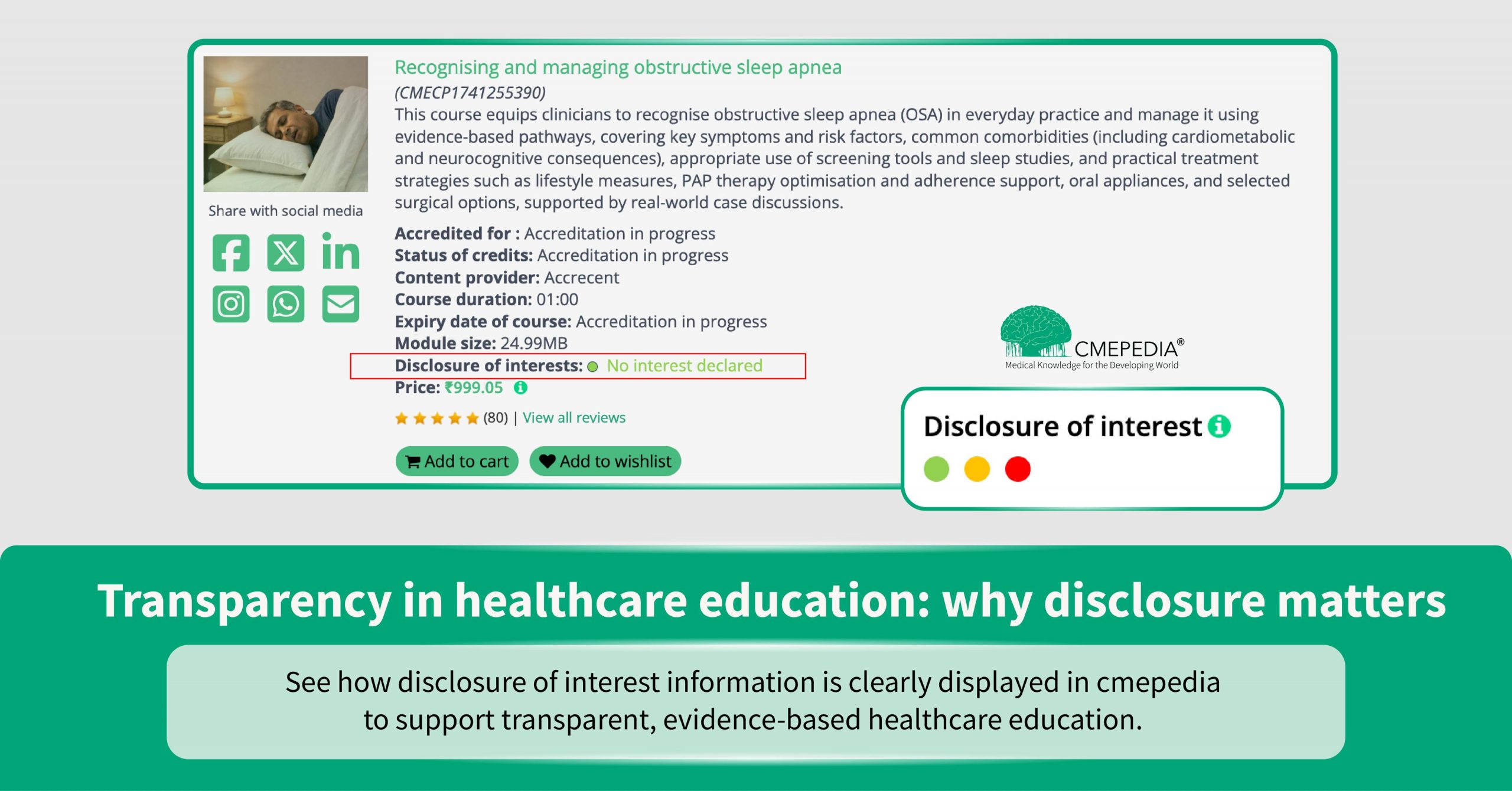
As India’s healthcare education ecosystem matures, transparency in healthcare education is becoming an important marker of credible and trustworthy learning. Much of this education is made possible through financial support from institutions, professional bodies, and, at times, the healthcare industry. This is not inherently a problem. The real question is not whether funding exists, but whether it is disclosed, and whether it influences the content learners receive.
As India’s healthcare education ecosystem matures, transparency around funding relationships is becoming a marker of trustworthy education. This piece looks at why disclosure matters, what makes industry support ethical, and how platforms like CMEPEDIA are built to protect the independence of what healthcare professionals learn.
What are conflicts of interest in healthcare education?
A conflict of interest arises when a financial or personal relationship has the potential to influence professional judgment, educational content, or research conclusions, regardless of whether it actually does. The International Committee of Medical Journal Editors (ICMJE) frames this clearly: public trust in scientific and educational content depends on how transparently these relationships are handled at every stage, from planning to publication.
In continuing medical education (CME), a conflict of interest could involve:
- A speaker being paid by a company whose product features in their presentation
- An educational module funded by an organisation with a stake in the clinical guidance being taught
- Faculty selection influenced by a sponsor’s commercial priorities
None of these situations are automatically unethical. The concern is influence that goes undisclosed or unmanaged.
Why transparency in healthcare education matters
Disclosure allows learners to evaluate information with full context. The World Medical Association’s Statement on Conflict of Interest notes that as private-sector involvement in medicine has grown, physicians increasingly work alongside industry as consultants, researchers, and educators, and recommends that continuing professional development actively build the skills to recognise and manage conflicts of interest, rather than treating disclosure as a formality.
The ICMJE’s long-standing position echoes this: purposeful failure to disclose relevant relationships is considered a form of misconduct, because it deprives readers and learners of information they need to interpret content accurately.
For healthcare professionals, this means every credible CME source should make its funding relationships, and the safeguards around them, visible and easy to find.
Industry funding is not automatically unethical
It is worth stating plainly: industry involvement in healthcare education is not, by itself, a red flag. Pharmaceutical, diagnostic, and medical device companies often hold deep clinical and scientific expertise, and their financial support has historically enabled research, conferences, and educational access that might otherwise be out of reach for many practitioners.
The World Medical Association has taken a similarly balanced position, noting that industry support helps physicians conduct research, attend scientific meetings, and stay informed about new developments and that rather than prohibiting these relationships outright, the more constructive path is to establish clear guidelines for how they operate.
The real issue is influence, not funding
The ethical line is not drawn at the source of funding. It is drawn at the point where funding begins to shape what is taught, who teaches it, or what conclusions are presented. Well-governed education keeps these two things, financial support and content control, clearly separated.
Principles that protect educational integrity
Several interlocking principles help keep healthcare education trustworthy, even when it is commercially supported:
- Editorial independence — Content decisions rest with qualified editorial and clinical teams, not funders.
- Transparency — Funding sources and the terms of that funding are disclosed openly.
- Conflict of interest disclosure — Faculty, authors, and reviewers declare relevant financial relationships.
- Scientific integrity — Claims are based on verified, current evidence rather than promotional material.
- Evidence-based education — Learning content reflects the best available clinical evidence, not commercial positioning.
These principles are reflected in internationally recognised guidance from organisations such as the Committee on Publication Ethics (COPE), as well as respected medical journals, professional bodies, and accredited education providers. Together, they help ensure healthcare education remains transparent, scientifically rigorous, and free from inappropriate commercial influence. These standards are also increasingly expected of digital CME platforms worldwide.
Unrestricted educational grants: A model for ethical support
One mechanism that allows industry support to coexist with editorial independence is the unrestricted educational grant. Under this model, an organisation provides financial support for an educational initiative but has no role in and no visibility into decisions about content, faculty selection, scientific conclusions, or learning outcomes before publication.
In practice, this means:
- The funder does not review or approve content before it is published
- Faculty and topics are chosen independently by the education provider
- The funder’s name may be disclosed as a supporter, but carries no editorial authority
This structure allows healthcare education to benefit from available funding while keeping the actual substance of learning insulated from commercial interest, provided the separation is genuinely maintained and consistently disclosed. This model is widely recognised across accredited continuing education programmes as an effective way to support education while protecting scientific independence
Where CMEPEDIA draws the line
CMEPEDIA’s approach to funding is built around this principle of separation. For CMEPEDIA, transparency in healthcare education means clearly separating financial support from editorial and clinical decisions. When the platform accepts support, it does so through unrestricted educational grants. Content development remains governed entirely by editorial policy, independent clinical expertise, and verified evidence, without commercial input.
Equally important is what CMEPEDIA chooses not to do. The platform does not collaborate with industries such as tobacco or alcohol. This is a deliberate boundary because these industries have inherent and well documented conflicts with public health goals. Association with them could compromise the credibility on which trustworthy healthcare education depends.
Maintaining distance from these industries protects more than CMEPEDIA’s reputation. It safeguards the scientific credibility that enables healthcare professionals to trust its educational content and supports the broader public health mission the platform exists to serve.
Why this matters for healthcare professionals in India
India’s regulatory conversation around doctor-industry relationships has been active in recent years, with the National Medical Commission proposing stronger restrictions on industry-sponsored CME as part of its 2023 professional conduct regulations. Regardless of how that regulatory landscape continues to evolve, the underlying principle is not in question: healthcare professionals are entitled to education that has not been shaped by commercial interest, and to clear information about who funds what they learn.
Greater transparency in healthcare education helps doctors, nurses, dentists, and allied health professionals assess whether CME content is independent, credible, and based on current evidence. For professionals balancing demanding clinical schedules with mandatory CPD requirements, this matters practically. It enables them to trust that a case study, treatment guideline, or CME module reflects scientific evidence rather than commercial positioning.
Conclusion
Transparency in healthcare education is not about eliminating industry involvement. It is about making funding relationships visible, keeping editorial decisions independent, and ensuring that what healthcare professionals learn is shaped by evidence rather than commercial interest. Disclosure, editorial independence, and mechanisms like unrestricted educational grants are how credible platforms make that possible.
As continuing healthcare education continues to evolve, transparency, editorial independence, and evidence-based learning remain essential for building trust. CMEPEDIA is committed to supporting healthcare professionals with educational content that reflects these principles while helping them stay current with reliable, clinically relevant knowledge.


