Industry funding in CME: Bias, transparency and trust
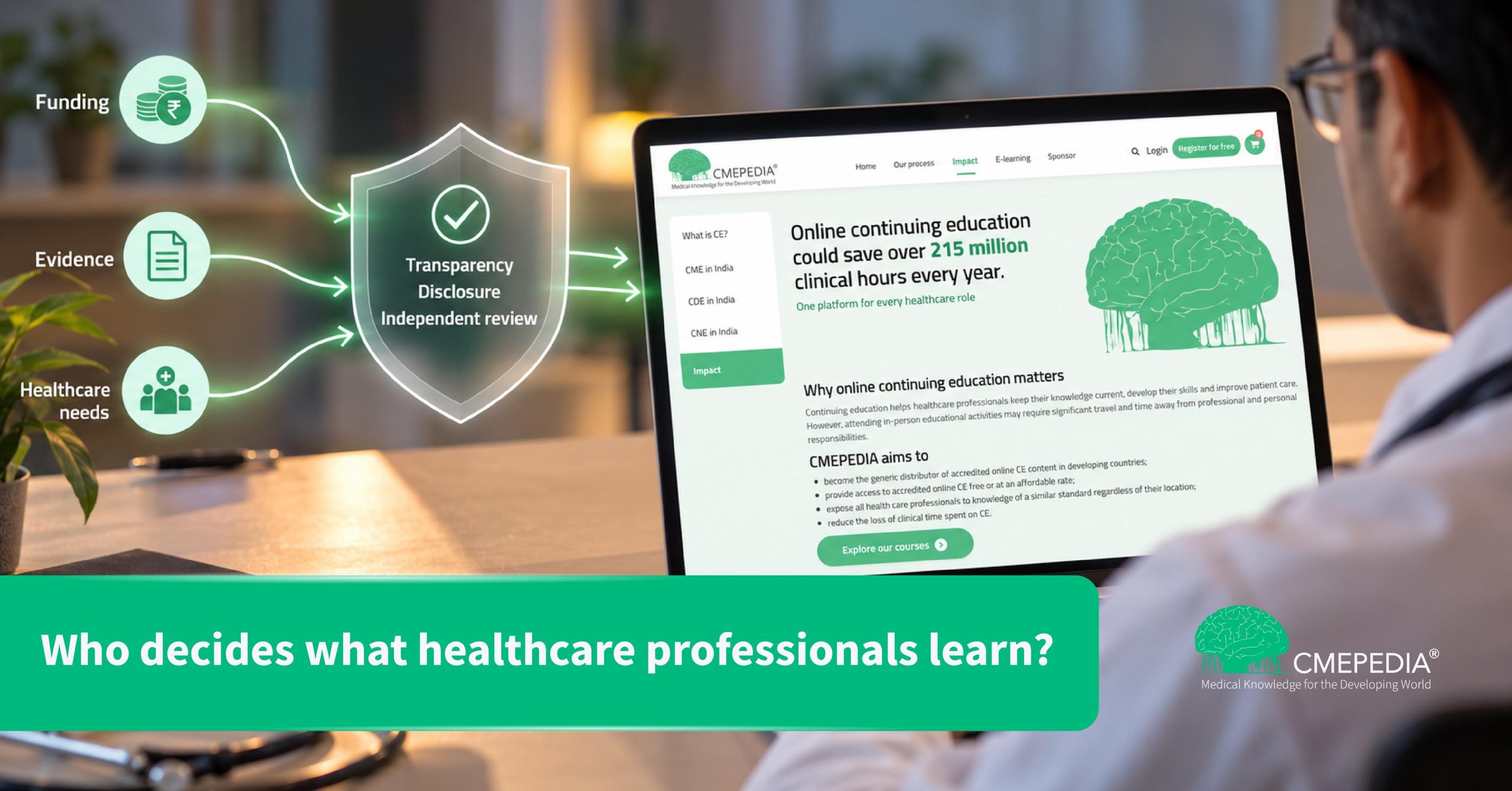
Industry funding in CME (Continuing Medical Education) helps support educational activities that enable healthcare professionals to keep pace with evolving evidence, treatments, and standards of care. However, commercial support can also raise questions about conflicts of interest, transparency, and educational independence.
Understanding industry funding in CME is essential for maintaining trust in medical education. While commercial support can provide valuable resources, transparent funding arrangements and independent educational decisions help ensure that learning remains evidence based and focused on healthcare professionals and patient needs.
Where conflicts of interest can enter CME
A conflict of interest can arise when a financial or commercial relationship has the potential to influence professional judgement or educational decisions. In CME, concerns may involve which topics receive attention, who delivers the education, how treatment options are presented and whether particular products or approaches receive disproportionate emphasis.
A 2024 BMJ analysis of industry payments to doctors in New Zealand examines concerns around commercial relationships in medicine, including their potential influence on medical knowledge, teaching and clinical practice.
This does not mean that every industry-funded educational activity is biased. Rather, financial relationships create potential conflicts that need to be recognised and managed through transparency, disclosure and safeguards that protect independent educational decision-making.
Can healthcare professionals recognise commercial bias?
Commercial influence is not always easy to recognise, particularly when exposure becomes part of medical training. A systematic review of medical students’ interactions with the pharmaceutical industry in Canada found that 40% to 100% of students across the included studies reported industry interactions. Eight studies also reported an association between more frequent contact and more favourable attitudes towards industry interactions.
However, this evidence primarily concerns medical students, with many studies conducted in the US and other high-income settings. It should not be generalised to practising healthcare professionals in India. It does, however, raise an important question: can commercial exposure eventually be associated with differences in prescribing practice?
Industry funding in CME in resource-constrained health systems
The relationship between funding and educational independence remains an important consideration in CME. In India, current programmes demonstrate that CME can receive institutional support alongside contributions from programme organisers. The National Academy of Medical Sciences’ 2024–25 annual report describes funding for extramural CME programmes, with proposals undergoing technical review before grants are approved and NAMS-appointed observers evaluating funded programmes.
Its January 2026 CME guidelines also require organisers to raise 15% to 20% of estimated programme expenditure through local resources, illustrating that CME funding can involve more than one source.
The key issue is therefore not simply whether an educational activity receives external funding, but whether appropriate safeguards preserve the independence of educational content, learning objectives, faculty selection and decision-making.
Protecting educational independence through transparency and governance
Protecting educational independence does not necessarily require eliminating every interaction between industry and medical education. The priority is to ensure that commercial support does not determine what healthcare professionals are taught or how evidence is presented.
Effective governance of industry funding in CME requires transparent financial disclosures, independent control of educational content, and safeguards against inappropriate commercial influence.
The ACCME Standards for Integrity and Independence provide one international framework for managing these relationships. They emphasise accurate and evidence-based education, identification and disclosure of relevant financial relationships, appropriate management of commercial support, and clear separation between accredited education and marketing.
The WFME standards for continuing professional development also provide a broader framework for developing and evaluating quality medical education across different settings. CMEPEDIA’s accredited activities can also be evaluated through the EBAC® framework, which provides standards for educational quality, independence and appropriate governance in continuing medical education.In practice, safeguards can include transparent funding disclosure, conflict of interest declarations, independent control of educational content, appropriate faculty selection, evidence-based development, editorial or peer review, separation from product promotion, and ongoing evaluation. These international frameworks are useful reference points rather than Indian regulatory requirements.
Building a sustainable approach to independent CME
Sustainable CME requires a model that uses available resources carefully while protecting evidence-based educational decision-making. This means considering not only how education is funded, but also how content is developed, reviewed, and distributed.
ACCRECENT develops continuing healthcare education for distribution through CMEPEDIA, while CMEPEDIA’s educational model includes evidence-based modules, peer review, and approaches designed to broaden access to continuing education. Its roadmap also describes adapting existing educational modules to the Indian context rather than recreating material unnecessarily.
This resource-conscious approach illustrates how CME providers can work towards sustainable content production while keeping educational quality and evidence at the centre of the learning process.
Funding should not determine what clinicians learn
Industry funding can provide valuable resources for continuing medical education, particularly where alternative funding is limited. However, funding relationships need to be balanced with transparency, appropriate disclosure and independent control over educational decisions.
The central question is therefore not only who pays for CME, but who decides what is taught and how those decisions are protected from inappropriate influence. Strong governance can help keep evidence and learning needs at the centre of continuing education. Healthcare professionals can explore evidence-based continuing education through CMEPEDIA.


